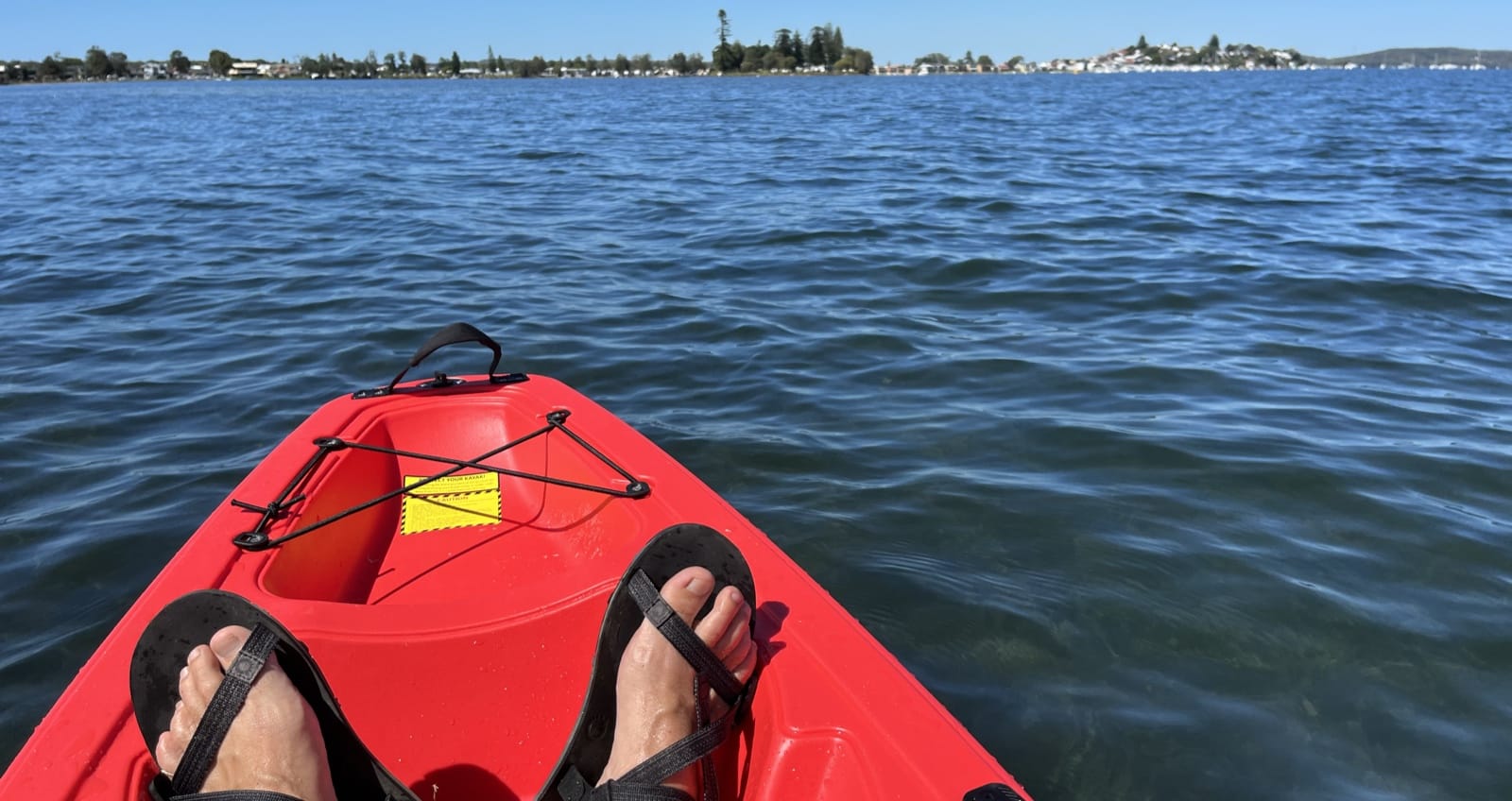
I’m sitting on my kayak on Lake Macquarie right now. It’s the largest saltwater lake in Australia — though it’s not really a lake, more of a lagoon, since it’s connected to the ocean. But what does my kayak trip have to do with artificial intelligence, as promised in the title?
On the kayak, I’m dictating into my Apple Watch. You should know I’m a massive fan of voice input and transcription. About four years ago, I dictated an entire book during a 25-kilometre hike from Wangen to Isny in southern Germany. Afterwards, though, it took me the better part of a year to edit that text — one endless sausage of words — into shape. It eventually became a small book.
Back then I dictated everything with full punctuation, but the transcription wasn’t good enough. Too imprecise, too much rework needed. So I dictated less and less. But that’s finally changed. While researching ChatGPT and friends, I also looked into other OpenAI services and stumbled across Whisper — their speech-to-text AI. I was keen to try it but couldn’t find a public service for it, until I discovered MacWhisper. A Dutch app developer wrapped the publicly available Whisper language pack — currently over three and a half gigabytes of data from about 100 languages — into a Mac app.
The beauty of it is that I don’t need an online service. MacWhisper runs locally on my Mac. That means my voice recordings aren’t sent to someone else’s server, unlike Dragon Dictate back in the day. So what does this have to do with AI? As I’ve written elsewhere, for me the point of AI isn’t to get things done faster — it’s to get them done better. That’s all it can be about.
I can use AI for impulses, for research, for refinement. Sure, AI thinks more precisely, knows more. So what? My thoughts are shaped by my upbringing and my experiences. That’s how I assess the world. And that’s my value — because unlike AI, which simply gathers everything together and, fascinatingly, assembles it all and presents it as an all-knowing result without citing sources, I only have a limited cone of knowledge. But that’s not necessarily a disadvantage. Only when I filter it through my own language, my own colours and emotions, does it become something that stirs people.
More time and peace to think
So when I’m sitting on my kayak, dictating texts in peace that I can later transcribe with MacWhisper in minutes and then work up further — that’s a huge milestone for me. Because the transcription quality is now genuinely good. It would be negligent not to use it. Combined with other AI tools, the result is better writing. Hopefully. Of course, you have to watch that texts don’t balloon endlessly now that you can speak them so quickly. So: kill your darlings.
Right now you’re hearing — no, reading — my voice. This is how you’d hear me at the kitchen table. These are all my brain’s twists and turns, and my name sits below or above them. Of course you can publish nameless, sourceless, all-knowing texts. But you can also offer your own vignettes, full of emotion, passion, love, grief, worry, fun, and who knows what else. Texts that move people. Everything else is nice, informative, good to know — but ultimately a waste of time. ChatGPT can spit out a 1-2-3 list, but I’d still rather follow the 1-2-3 list of an experienced human with a face and a story than an amalgam of best-of information.
The ChatGPT lucky dip — how “old” and experienced is the knowledge?
I used to not care much about authors or their age. Only the content mattered. Life experience? Overrated. At 30, I thought I knew everything. Now, more than 20 years later, I see it differently. I know what I don’t know. And that’s a lot. That’s why I’m sceptical when a twenty-something influencer tries to hand me big life wisdom. Perhaps I’m more drawn to books by older people — or those long dead. What did they figure out? My worry is that ChatGPT mainly values the knowledge of younger people, because many older, more experienced people don’t share their wisdom online as much. I’d rather listen to a battle-hardened expert who’s seen it all, understands the connections, and can size up every new development. Think Peter Scholl-Latour — a journalist who’d seen every conflict zone on earth and could put any headline into context.
So my counter-programme to ChatGPT is this: find the old, the experienced people, and keep working on thinking for yourself. Crooked thinking and missteps are part of it. My notes will keep being notes with unfinished in-between states, with questions, doubts, and plenty of wonder. Because that’s what makes us human.
I’ve been sitting nearly motionless on this kayak for about 25 minutes now. The current’s drifted me out quite far. A huge fish just leapt out of the water in front of me, and a small bull shark glided underneath. These are experiences no machine can give me — the kind that enrich my life. And that’s why I’ll keep writing human notes and stop writing about ChatGPT and artificial intelligence. Well, maybe. We’ll see.