They hit without warning — those well-meaning tips, advice from someone who knows better, people who care about us, or just words like “That was pretty good, but next time: xxx.” Straight to the heart. We’re wounded and don’t even know what happened.
It’s like a kidney punch. We’re on the mat, briefly unconscious. What just happened? We received feedback.
The reverse happens too. You give harmless feedback like “you ignored me the whole time, maybe you could pay more attention next time, I had interesting things to share” and suddenly you’re hit by a fire hose. Completely unexpected. You must have pressed a special button. Wasn’t meant that way, just needed to come out.
Does replacing “but” with “and” work?
Giving feedback is an art. Everyone has their style. Some prepare unpleasant feedback like this: “I know you won’t like this, BUT (… I’m saying it anyway, even though I can see you’re already crouching and gathering strength to defend yourself).” Or: “You’re such a good colleague and I value our collaboration, BUT (… now disaster’s coming for you, because none of this counts once I finish this sentence).”
We’re programmed this way. BUT means: here comes the bad news. Sure, you could change this by replacing BUT with AND. That works better: “I genuinely appreciate your work AND I’d like you to clean up everything next time, because I feel better when the desk is clear.” Nobody quite expects an AND, so it lands better. I’ve been trying to avoid BUT in speech for years. Works pretty well, but — here it’s allowed — this small trick isn’t enough for tougher feedback. It still flies around ears even with a smooth AND. Why?
Giving feedback is like playing tennis
I’m reading an interesting book that addresses “giving feedback” across several chapters. It’s called “Connect” by Dave Bradford and Carole Robin. Essential reading for me — I’ll definitely give it a proper book note later.
In Connect, the authors suggest seeing feedback like a tennis game. Naturally you think of an eternally long (boring) back-and-forth with lots of grunting, but the image is different: In tennis, everyone stands on their side and can only intrude into opponent airspace with their racquet at the net. Otherwise: stay in your field.
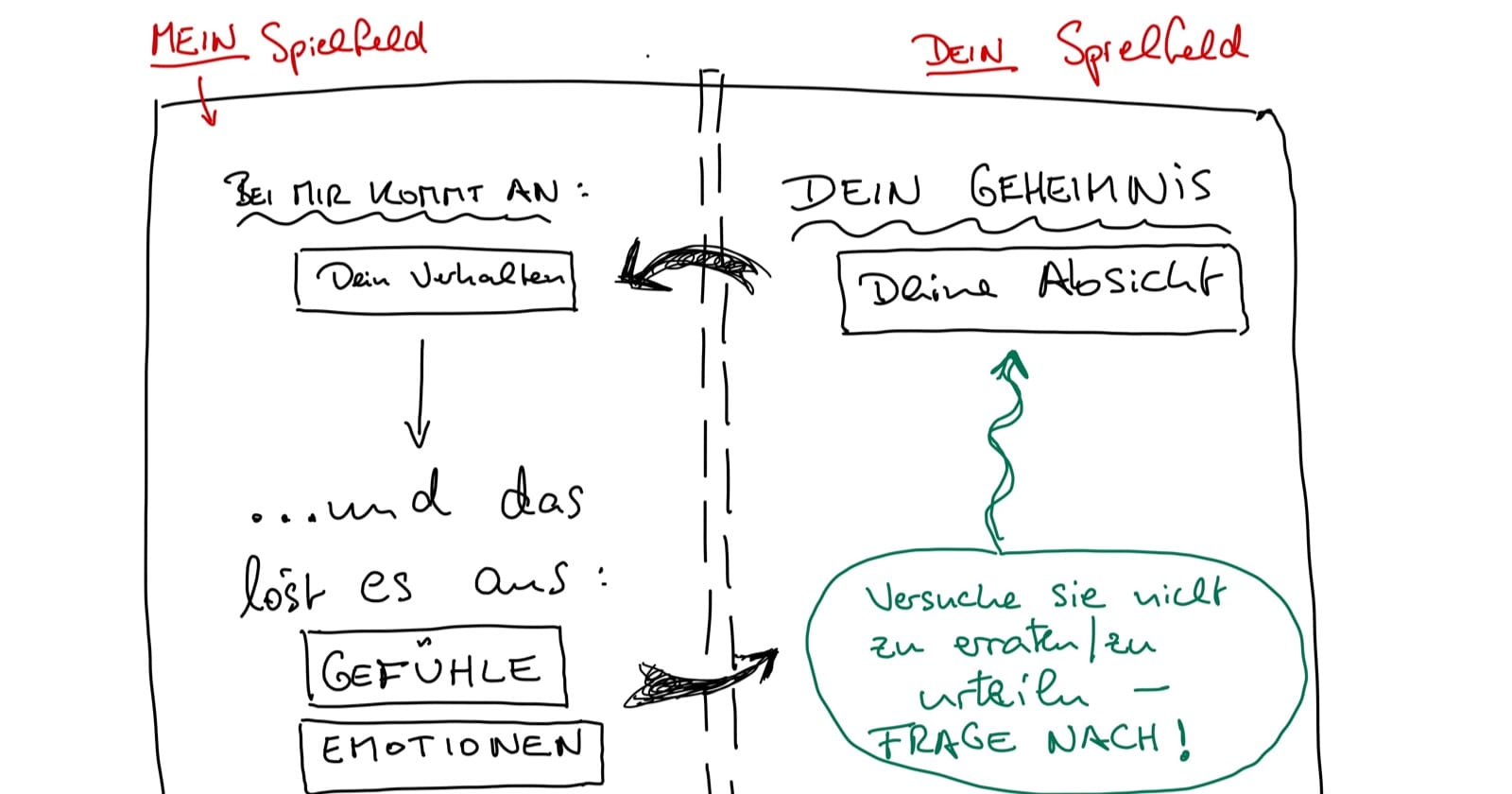
Why you should always stay in your field
That alone is an important insight for me. I should stay on my own field. Too often when giving feedback, I’d leap over the net with momentum and verbally grab the other person by the throat: “Listen mate, you really… and anyway, why do you want to annoy me, what’s your problem?”
What happens when we only stay in our field? We observe. We note the other person’s behaviour and words and what they trigger in us — feelings, reactions, actions. Nothing more. That’s all that reaches us. Staying with the tennis metaphor: the other person hit the ball with their racquet to our side and has to wait for the ball to come back. Either it returns as expected or surprisingly as a drop shot just behind the net, a smash, or a long ball down the sideline.
Never jump over the net
The fascinating thing about the game and about giving feedback is that we’ll never decode the player’s intention on the other side. We think we know, we have lots of assumptions and maybe experience from the past. But we still don’t know why the other person said something, did something, or didn’t say and do something.
Intention belongs to the player on the other field. But this also means we never know exactly how our long ball lands on the other side of the net. We can sense the reactions and extent, but we don’t really know what effect we’ve achieved. Well then, talk about it! But how?
Clear feedback is a gift
In Connect, the authors recommend “behavioural feedback.” We give the other person insight into our soul by clearly reporting what a concrete situation triggered in us. “When you interrupted me during topic xyz in the meeting and changed the subject, I felt suppressed.” Ah. Maybe that wasn’t the other person’s intention at all — they simply had the clock in mind and wanted to speed up the meeting. More can grow from this feedback. The other person doesn’t need to defend themselves but gets the opportunity for interested follow-up: Suppressed? That wasn’t my intention at all… An open conversation emerges.
When you meet people who take this kind of feedback constructively, you’re giving them a valuable gift. They learn something about themselves, get insight into an otherwise blind spot. They don’t feel patronised. At the same time, you learn it’s worth giving clear feedback instead of swallowing everything and falling into deep cynicism. And if the other person doesn’t accept the gift, that’s not a problem. It takes two to tango.
From the archives of reinergaertner.de, running since 1997. Translated with AI help and my questionable bilingual proofreading. If you spot a Germanismus — that’s a feature, not a bug.